
Medical appointments rarely go exactly according to plan. One patient may need only a quick follow-up, another may have several questions, someone may arrive late, and another patient may cancel at the last minute.
When every appointment is booked into a strict 15- or 20-minute slot, even one delay can affect the rest of the day.
That is where wave scheduling can help. Instead of expecting every visit to start and finish at an exact time, wave scheduling gives medical practices more flexibility to manage different appointment lengths and changing patient needs.
What Is Wave Scheduling?
Wave scheduling is a medical appointment scheduling method where more than one patient is booked within the same general time period rather than giving every patient an evenly spaced appointment slot.
For example, a clinic might schedule:
- Two patients at 9:00 AM
- One patient at 9:30 AM
- Two patients at 10:00 AM
The provider then sees patients based on who is ready and how much time each visit requires.
The purpose is not simply to squeeze more appointments into the day. A well-planned wave schedule creates some breathing room when a visit takes longer than expected or another appointment finishes quickly.
How Does Wave Scheduling Work in a Medical Clinic?
Imagine a family practice that normally books one patient every 20 minutes:
- 9:00 AM — Patient A
- 9:20 AM — Patient B
- 9:40 AM — Patient C
This looks organized, but it depends on everything running exactly on time.
Suppose Patient A only needs a quick medication follow-up and finishes in 10 minutes. The provider may have unused time before Patient B arrives.
Now imagine the opposite. Patient A has additional concerns and needs 30 minutes. Patient B and Patient C may then start waiting.
With wave scheduling, the clinic might instead use:
9:00 AM
- Patient A — routine follow-up
- Patient B — medication review
9:30 AM
- Patient C — follow-up consultation
If Patient A finishes quickly, Patient B may already be ready. If Patient B is still completing check-in, the provider may be able to start with Patient A.
The schedule becomes more flexible instead of depending on every appointment fitting perfectly into a fixed time slot.
A Simple Wave Scheduling Example
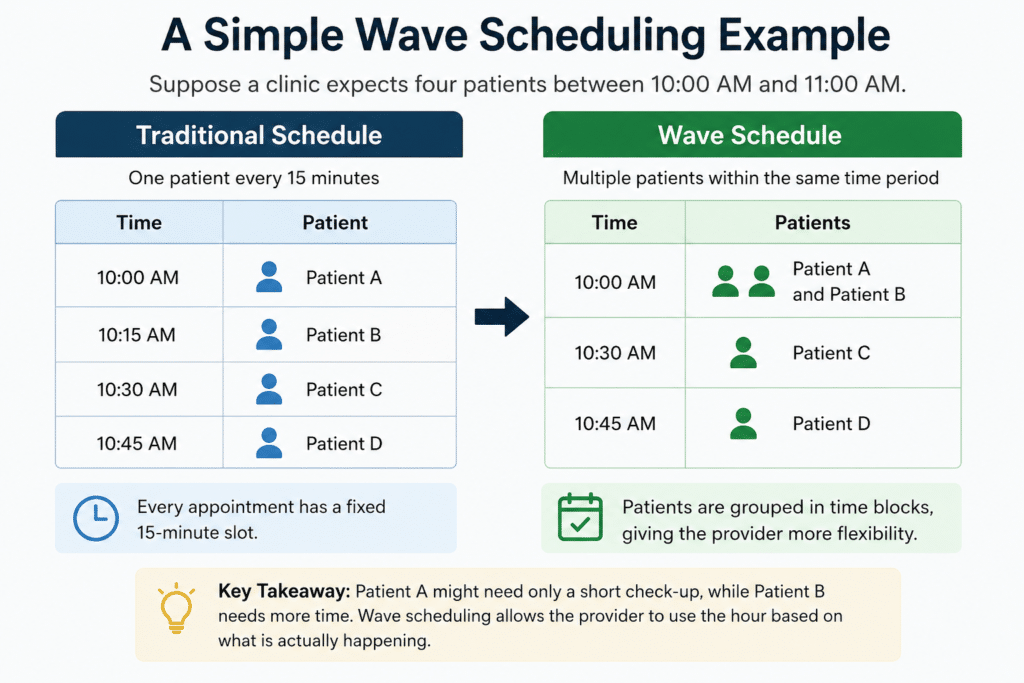
Suppose a clinic expects four patients between 10:00 AM and 11:00 AM.
A traditional schedule might look like this:
| Time | Patient |
|---|---|
| 10:00 AM | Patient A |
| 10:15 AM | Patient B |
| 10:30 AM | Patient C |
| 10:45 AM | Patient D |
With wave scheduling, the clinic may organize the hour differently:
| Time | Patients |
|---|---|
| 10:00 AM | Patient A and Patient B |
| 10:30 AM | Patient C |
| 10:45 AM | Patient D |
Patient A might need only a short check-up, while Patient B needs more time.
Instead of treating every patient as if they need exactly 15 minutes, the provider has more flexibility to use the hour based on what is actually happening.
Why Do Medical Clinics Use Wave Scheduling?
Healthcare appointments can be unpredictable. Even patients coming in for similar reasons may need very different amounts of time.
Wave scheduling helps practices manage some of that variation.
1. It Gives Providers More Flexibility
If one appointment finishes early, another patient may already be available.
This can reduce unnecessary gaps in the provider’s day.
2. It Helps Manage Different Appointment Lengths
A routine follow-up may take much less time than a new-patient consultation.
Wave scheduling gives clinics room to handle these differences without constantly rearranging the rest of the calendar.
3. It Can Reduce the Impact of No-Shows
A missed appointment can leave an empty period in a traditional schedule.
With wave scheduling, another patient may already be available during that time.
This does not replace reminders or appointment confirmations, but it can make an unexpected no-show less disruptive.
4. It Can Make Busy Periods Easier to Manage
Practices with a steady patient volume need to balance provider time with reasonable patient waiting times.
A carefully planned wave schedule can help create more flexibility during busy hours.
What Are the Benefits of Wave Scheduling?
When used properly, wave scheduling can offer several practical benefits.
Better Use of Provider Time
Providers may have another patient ready when an appointment ends early, is cancelled, or does not show up.
More Realistic Scheduling
Not every medical visit takes exactly the same amount of time. Wave scheduling recognizes that instead of forcing every appointment into an identical block.
More Flexibility Around Delays
Late arrivals and longer consultations may be easier to manage without pushing every appointment that follows further behind.
Easier Adjustment to Daily Changes
Healthcare schedules change throughout the day. Wave scheduling provides some room to adjust without completely reorganizing the calendar.
What Are the Disadvantages of Wave Scheduling?
Wave scheduling is not automatically better than traditional scheduling.
If it is poorly planned, it can create new problems.
Patients May Wait Longer
If several patients arrive together and every visit takes longer than expected, waiting times can increase quickly.
The Front Desk Can Become Busier
Several patients arriving within the same period can mean multiple check-ins, questions, calls, and scheduling requests happening at once.
It Requires Careful Planning
A practice should understand:
- Typical appointment lengths
- Provider capacity
- Patient arrival patterns
- No-show rates
- Available staff
- Which appointments usually require more time
Simply booking several patients at the same time is not an effective scheduling strategy.
Wave Scheduling vs Modified Wave Scheduling
Wave scheduling and modified wave scheduling are closely related, but there is a difference.
Traditional wave scheduling generally groups several patients near the beginning of a scheduling period.
Modified wave scheduling spreads appointments more gradually throughout the hour and may leave some additional time for the provider to catch up.
For example:
Wave scheduling
- 9:00 AM — three patients
Modified wave scheduling
- 9:00 AM — two patients
- 9:20 AM — one patient
- 9:40 AM — one patient or buffer time
For readers who want a more detailed comparison, internally link this section to your existing Wave vs Modified Wave Scheduling guide.
How Can Clinics Make Wave Scheduling Work Better?
Choosing a scheduling method is only one part of the process. How appointments are managed throughout the day matters just as much.
Review Real Appointment Patterns
Look at which types of visits regularly finish quickly and which usually take longer.
This helps the practice build its schedule around actual patient behavior rather than assumptions.
Avoid Overloading Each Wave
Wave scheduling should create flexibility, not overcrowding.
Booking too many people together may simply replace provider downtime with longer patient waits.
Keep Appointment Confirmations Organized
Reminders and confirmations help practices know which patients are likely to arrive.
When cancellations happen, the schedule can be updated quickly.
Create a Clear Rescheduling Process
Patients will sometimes need to change appointments.
Having a consistent process for cancellations, rescheduling, and calendar updates can help prevent available appointment times from being overlooked.
For practices handling a high volume of scheduling calls, appointment setting services can support routine administrative tasks such as booking appointments, confirmations, rescheduling, and calendar updates.
Internally link appointment setting services to your relevant service page.
Where Can Virtual Assistants Support Appointment Management?
A good scheduling method still depends on someone keeping the administrative side organized.
An administrative virtual assistant can support routine scheduling activities such as:
- Answering appointment-related calls
- Booking patients according to existing guidelines
- Updating calendars
- Managing appointment confirmations
- Handling rescheduling requests
- Following up on routine scheduling questions
The role of an administrative virtual assistant is not to decide how a medical practice should structure its patient schedule. The clinic establishes the scheduling rules, while administrative support helps carry them out consistently.
Internally link administrative virtual assistant to your Virtual Assistant service page.
Virtual Assistants can be particularly useful when front-desk staff are already balancing incoming calls with patients physically waiting in the clinic.
Similar appointment coordination may also be important in Personal Injury Support, where legal teams, clients, and medical providers may need to stay aligned around appointments and ongoing communication.
Is Wave Scheduling Right for Every Medical Clinic?
No.
Wave scheduling may make sense for practices where:
- Appointment lengths regularly vary
- No-shows create frequent gaps
- Providers see a relatively high number of patients
- Many visits are short follow-ups
- The clinic needs more flexibility throughout the day
It may be less suitable when most appointments require long, predictable blocks of time or when the clinic does not have enough staff to manage several patients arriving close together.
Before changing the schedule, practices should look at their own waiting times, appointment patterns, patient volume, and staffing capacity.
Frequently Asked Questions
What is wave scheduling in healthcare?
Wave scheduling is a method where several patients are booked within the same general scheduling period. This gives healthcare providers more flexibility when appointment lengths vary.
What is an example of wave scheduling?
A clinic might schedule two patients at 9:00 AM and another patient at 9:30 AM instead of booking one patient every 20 minutes.
What is the main advantage of wave scheduling?
The main advantage is flexibility. Providers can adjust more easily when an appointment finishes early, takes longer than expected, or is affected by a cancellation.
What is the biggest disadvantage of wave scheduling?
Waiting times can increase if too many patients are booked in the same wave or if the clinic does not have enough staff to manage grouped arrivals.
Can wave scheduling help with patient no-shows?
It can reduce some of the disruption caused by a no-show because another patient may already be available during the same scheduling period. Reminders and confirmations are still important.
What is the difference between wave and modified wave scheduling?
Wave scheduling generally groups patients more closely together. Modified wave scheduling spreads appointments more gradually throughout the hour and may include additional catch-up or buffer time.
Can an administrative virtual assistant help with medical appointment scheduling?
Yes. Once a practice establishes its scheduling process, an administrative virtual assistant can help with bookings, confirmations, rescheduling requests, and calendar updates.
Can appointment setting services help medical clinics?
Yes. Appointment setting services can support medical practices with routine scheduling tasks such as handling appointment requests, confirmations, rescheduling, and calendar management. This may be useful when internal staff are also managing patients already in the clinic.
Final Thoughts
Wave scheduling is built around a simple reality: medical appointments do not always take exactly the same amount of time.
By grouping patients strategically, clinics can create more flexibility for shorter visits, longer consultations, no-shows, and everyday delays.
But wave scheduling should not be confused with simply booking more patients at once. It works best when practices understand their appointment patterns, avoid overcrowding, and keep confirmations, cancellations, and rescheduling organized.
For some clinics, wave scheduling may improve patient flow and make better use of provider time. For others, modified wave scheduling or traditional appointment slots may be a better fit.
The right approach is the one that keeps the clinic running smoothly while still providing patients with a manageable and respectful experience.