
AI hasn’t replaced outsourced sales teams in 2026 — it’s made them faster and more precise. Outsourced reps now use AI for prospect research, lead scoring, and personalized outreach at scale, while humans still handle the relationship-building and closing that AI can’t replicate. For small businesses, this means access to enterprise-level sales efficiency without the cost of building an AI-powered sales stack in-house.
If you run a small business, your problem probably isn’t a lack of leads — it’s not having the time, team, or budget to work them properly. Maybe you’ve got a handful of people wearing five hats each. Maybe you tried an AI sales tool that promised the world and delivered a pile of generic emails nobody answered. Maybe you’re just not sure if outsourcing still makes sense now that “everyone has AI.”
Those are fair concerns, and they’re the reason this topic actually matters in 2026 — not because AI is a buzzword, but because it’s changed what a good outsourced sales team can realistically do for a business your size. Here’s what’s actually changed, what hasn’t, and how to tell the difference.
Is AI Replacing Outsourced Sales Reps?
No — and this is worth saying plainly, because a lot of the noise around AI in sales implies otherwise. What’s actually happened is more useful: AI has taken over the slow, repetitive parts of selling — research, data entry, initial drafts — so human reps spend more time on the parts that actually close deals: conversations, objection handling, and trust-building.
According to Salesforce’s State of Sales research, sales teams using AI are about 1.3 times more likely to report revenue growth than teams that don’t, largely because reps get more selling time back. For a small business, that translates into a simple benefit: your outsourced reps can cover more ground without sounding like a robot wrote their emails.
The Real Pain Points AI Is Actually Solving
Before getting into trends, it helps to name the specific problems small businesses run into with sales — because these are exactly what AI-enabled outsourcing is built to fix:
- “We don’t have time to qualify every lead.” AI-driven lead scoring now ranks prospects automatically based on engagement, company growth, and buying signals, so reps focus on leads most likely to convert instead of working a list blind.
- “Our outreach gets ignored.” Generic templated emails are largely tuned out or filtered as spam today. AI helps reps personalize outreach at scale, referencing real context about a prospect’s business instead of a copy-paste line.
- “We can’t afford a full sales team, but we’re losing deals to slow follow-up.” AI tools flag the right moment to follow up based on real behavior, not guesswork, which matters most when you don’t have reps to spare for manual tracking.
- “We tried an AI tool and it didn’t work.” Software alone doesn’t fix this — it needs a trained person interpreting the data and having the actual conversation. That’s the gap outsourcing fills.
How Does AI Personalization Work in Outsourced Sales?
AI tools now let sales reps research a prospect’s company, role, and recent activity in seconds instead of the twenty-plus minutes it used to take. The rep then uses that context to write outreach that reads like it was written specifically for that person — because functionally, it was.
This is different from the AI sales tools flooding the market that just auto-generate emails with no human review. In a well-run outsourced setup, AI handles the research and drafting; a trained sales virtual assistant or rep reviews, adjusts tone, and sends it. That combination is what actually gets replies, not AI output alone.
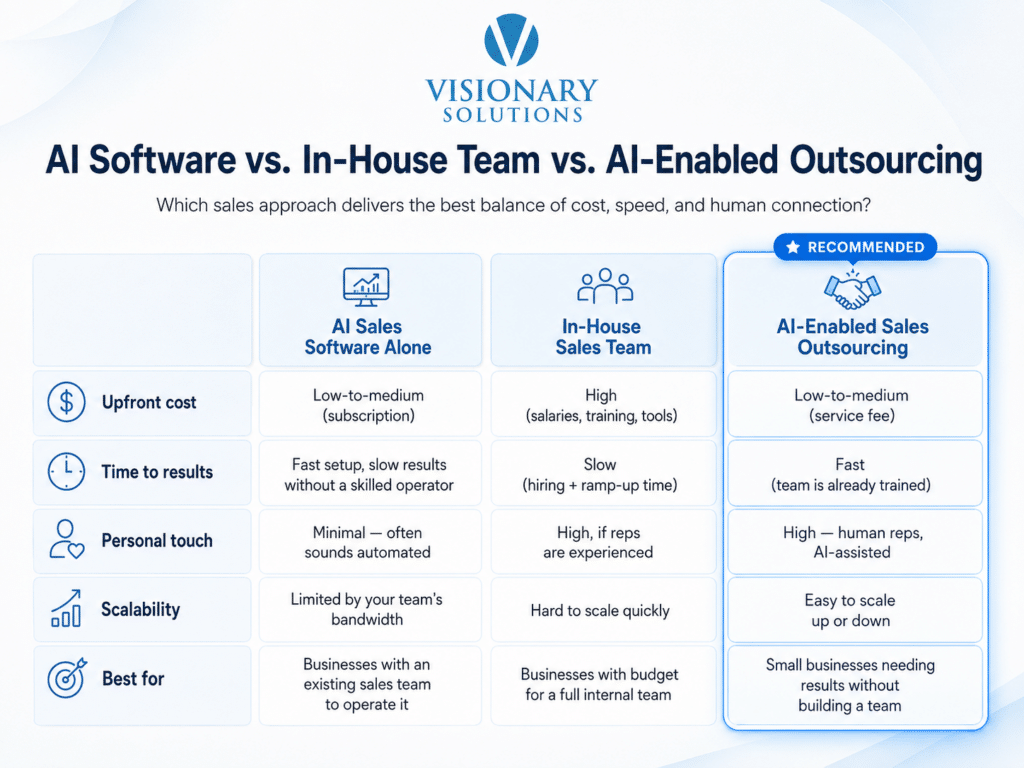
AI Software vs. In-House Team vs. AI-Enabled Outsourcing
| AI Sales Software Alone | In-House Sales Team | AI-Enabled Sales Outsourcing | |
|---|---|---|---|
| Upfront cost | Low-to-medium (subscription) | High (salaries, training, tools) | Low-to-medium (service fee) |
| Time to results | Fast setup, slow results without a skilled operator | Slow (hiring + ramp-up time) | Fast (team is already trained) |
| Personal touch | Minimal — often sounds automated | High, if reps are experienced | High — human reps, AI-assisted |
| Scalability | Limited by your team’s bandwidth | Hard to scale quickly | Easy to scale up or down |
| Best for | Businesses with an existing sales team to operate it | Businesses with budget for a full internal team | Small businesses needing results without building a team |
Why This Matters More for Small Businesses Than Enterprises
Large companies can afford to build internal AI-powered sales stacks and spend months testing what works. Most small businesses can’t absorb that kind of trial and error. This is exactly why AI-enabled outsourcing has become less of a cost-cutting move and more of a genuine growth strategy — it gives a small business the same kind of efficiency a much bigger company would build in-house, without the hiring risk or the tech overhead.
Deloitte’s most recent Global Outsourcing Survey found that cost savings has fallen as the top reason companies outsource — down to about a third of respondents, from roughly seven in ten a few years ago — with access to skilled talent and technology now ranking just as high. That shift matters: businesses aren’t outsourcing sales just to save money anymore. They’re doing it to get capabilities they couldn’t otherwise afford, and AI is a big part of that capability.
If you’re already stretched thin on hiring, this is often the same logic behind outsourcing other roles like customer support or admin work — the efficiency gains tend to compound across a business, not just in sales.
What to Look for in an AI-Enabled Sales Outsourcing Partner in 2026
- Ask how they use AI, specifically. Nearly every provider claims to “use AI” now. Ask exactly where it fits — research, lead scoring, personalization — and where a human takes over.
- Check their reporting. AI makes real-time tracking of calls, conversions, and pipeline activity easy. A good partner shows you this data clearly, not just in a monthly summary.
- Weigh experience over buzzwords. A provider with years of track record that’s added AI to a proven process is usually a safer bet than a brand-new “AI-first” company with no history.
- Consider time zone and cultural fit. Even with AI doing more behind-the-scenes work, a nearshore team working in your time zone still makes collaboration and quality control easier than an offshore team you rarely sync with live.
- Look at their own track record with similar businesses. A provider that can point to proven results with companies your size is a stronger bet than one relying on general promises.
Frequently Asked Questions
Does AI replace the need for outsourced sales teams?
No. AI handles research, data analysis, and drafting, but human reps still do the relationship-building, objection handling, and closing that actually drive revenue. The two work best together.
Is AI-enabled sales outsourcing expensive for small businesses?
Generally, it costs less than hiring an in-house team and provides faster results than a small business trying to build its own AI sales stack from scratch, since the tools, training, and process are already in place.
How is AI sales outsourcing different from just buying AI sales software?
Software alone requires someone skilled to run it, interpret the data, and have the actual sales conversations. Outsourcing gives you both the AI tools and the trained people using them.
What should a small business ask before hiring an AI-enabled sales outsourcing provider?
Ask specifically how AI is used in their process, how they report results, how long they’ve been in business, and whether they have experience with companies of a similar size.