
Key Takeaways
- Businesses reduce recruitment and onboarding costs significantly
- Operational infrastructure expenses become lower
- Outsourcing improves flexibility and scalability
- Internal teams experience less operational overload
- Businesses gain access to trained support teams faster
- Workflow organization and communication efficiency improve
- Long-term operational profitability becomes easier to maintain
Operational costs are getting to be one of those biggest growth hurdles for companies across the United States. Hiring spend keeps climbing, customer expectations are going up, and holding onto big internal teams has become way more expensive than it was just a few years back. Because of that, lots of businesses are now trying to juggle operational efficiency with profitability but still keep service quality steady and scale up when needed, you know.
This is honestly one of the main reasons why more businesses will be teaming up with top BPO providers in 2026.
From startups all the way to enterprise organizations, businesses are increasingly leaning on business process outsourcing firms to manage repetitive operational processes while internal teams can spend more time on strategy, expansion, and customer connections. In plenty of situations, companies that roll out structured outsourcing programs are cutting running costs by 40–60% compared with keeping the same work in-house.
Why Operational Costs Continue Rising for US Businesses
Running internal operations involves far more than salaries alone.
Businesses also absorb costs related to:
- recruitment
- onboarding
- training
- management oversight
- payroll taxes
- office infrastructure
- communication systems
- employee equipment
- software access
- operational administration
As companies grow, these expenses scale aggressively alongside customer demand and operational complexity.
At the same time, businesses are expected to:
- respond faster
- improve customer experience
- maintain operational consistency
- support growing workloads
- scale communication efficiently
This creates significant pressure on internal teams and operational budgets.
That’s where a strong bpo service provider creates long-term operational value.
How Top BPO Companies Reduce Operating Costs
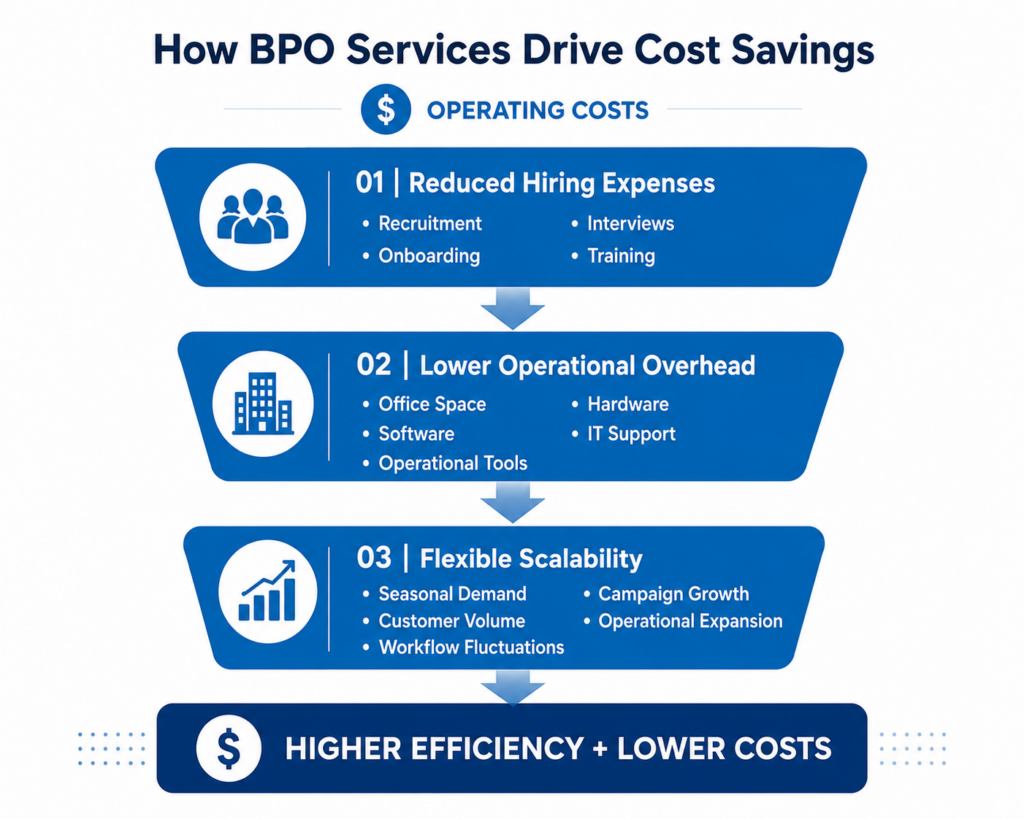
1. Reduced Hiring and Recruitment Expenses
Internal hiring is expensive, time-consuming, and difficult to scale quickly.
Businesses spend heavily on:
- recruitment platforms
- interviews
- onboarding
- training
- HR coordination
A reliable outsourcing partner already has trained operational teams in place, allowing businesses to scale support faster without repeating long hiring cycles every time operational demand increases.
This significantly reduces:
- recruitment delays
- onboarding expenses
- internal HR workload
- training costs
over time.
2. Lower Infrastructure and Operational Overhead
Maintaining internal teams requires continuous investment in:
- office space
- hardware
- communication systems
- management software
- IT support
- operational tools
Modern BPO services in usa already operate with established infrastructure and support systems, allowing businesses to avoid large internal operational investments.
This creates major long-term savings while also improving flexibility.
3. Better Scalability Without Expanding Internal Teams
One of the biggest advantages of outsourcing is operational scalability.
Businesses can scale support according to:
- seasonal demand
- customer volume
- campaign growth
- operational expansion
- workflow fluctuations
without rebuilding internal infrastructure repeatedly.
Companies using:
- virtual assistant services
- sales outsourcing services
- customer support services
can expand operations much faster while maintaining leaner internal teams.
BPO vs Hiring In House: Which Is More Efficient?
The conversation around BPO vs hiring in house has changed significantly over the last few years.
Businesses are no longer comparing only salaries. They are comparing:
- scalability
- workflow efficiency
- operational flexibility
- management overhead
- response times
- communication consistency
- long-term operational sustainability
Internal hiring provides direct control, but it also increases:
- payroll obligations
- infrastructure costs
- management pressure
- training responsibilities
- operational overhead
Outsourcing provides:
- faster deployment
- lower operational costs
- scalable support
- flexible workforce management
- specialized operational expertise
For many growing companies, outsourcing creates a more efficient long-term operational structure.
Where Businesses See the Highest ROI From Outsourcing
The strongest ROI usually comes from outsourcing repetitive workflows that consume large amounts of internal time daily.
Businesses commonly see the highest value in:
- customer support operations
- administrative coordination
- sales support
- lead qualification
- appointment scheduling
- back-office operations
- reporting workflows
The operational savings increase over time because internal teams spend less time on repetitive coordination work and more time on higher-value business activities.
What Businesses Should Look for in a BPO Service Provider
Not every outsourcing company delivers the same operational quality.
The best top BPO companies focus on:
- workflow consistency
- communication quality
- operational transparency
- scalability
- reporting visibility
- long-term operational alignment
A reliable bpo service provider should function like an operational extension of the business rather than simply acting as a staffing vendor.
Businesses should avoid providers that:
- rely only on pricing as a selling point
- lack structured communication
- provide vague operational workflows
- offer limited reporting visibility
- struggle with scalability
Strong outsourcing partnerships are built around operational efficiency and communication consistency.
Why More Businesses Are Using BPO Services in 2026
Businesses today are under constant pressure to grow faster while operating leaner.
That is why outsourcing adoption continues increasing across industries like:
- healthcare
- real estate
- SaaS
- eCommerce
- legal services
- finance
- professional services
Modern outsourcing is no longer only about reducing labor costs.
Businesses are outsourcing to:
- improve operational efficiency
- streamline workflows
- reduce internal overload
- improve customer communication
- maintain scalability
- increase operational flexibility
This shift is changing how businesses approach growth and operations heading into 2026.
Final Thoughts
Outsourcing has evolved far beyond traditional cost reduction.
Today’s top BPO companies help businesses create more scalable, organized, and efficient operational systems while reducing overhead costs significantly compared to building large internal departments.
For many companies, the biggest advantage is not simply saving money. It is gaining operational flexibility while maintaining workflow consistency and communication quality during growth.
Whether businesses are outsourcing customer support, administrative coordination, sales workflows, or backend operations, the right outsourcing partnership can improve operational efficiency while reducing costs by 40–60% over time.
As operational demands continue increasing in 2026, strategic outsourcing is becoming less of a temporary business solution and more of a long-term operational advantage.
FAQs
- How do top BPO companies help cut down operating costs ?
They reduce recruitment expenses, infrastructure costs, onboarding overhead, and internal operational work, all that while boosting workflow efficiency, which is kinda the point.
- What is the biggest difference between BPO vs hiring in house ?
When you hire in-house you tend to carry higher long-term operational costs. Outsourcing on the other hand offers more flexibility, scalability, and generally lower overhead, so things stay lighter.
- What services do business process outsourcing companies provide ?
Most of the time they cover customer support, sales support, administrative assistance, lead management, virtual assistance, and back-office operational services, depending on what you need.
- Are BPO services in usa suitable for small businesses ?
Yes, plenty of small businesses use outsourcing to get better efficiency without building big internal operational teams. This helps them stay lean.
- What should businesses look for in a bpo service provider ?
They should focus on communication quality, workflow organization, scalability, operational transparency, and long-term reliability. If any one of those feels off, it can turn messy later.