Running a small or medium-sized business often means wearing multiple hats. One minute you’re replying to customer emails, the next you’re posting on social media, updating spreadsheets, or following up with leads. While these tasks are important, they also take time away from growing your business.
That’s why more companies are investing in virtual assistant services for small and medium businesses. The global virtual assistant market is projected to reach USD 14.10 billion by 2030. Instead of hiring full-time employees for every role, business owners are choosing skilled virtual assistants who can handle day-to-day work remotely. It’s a flexible way to get expert support without the cost and commitment of building a larger in-house team.
The challenge is knowing where to start. Should you hire an administrative virtual assistant, a digital marketing virtual assistant, or a sales virtual assistant? How much does a virtual admin assistant cost? And which option makes the most sense for your business?
This guide answers those questions and helps you choose the right virtual assistant based on your goals, budget, and stage of growth.
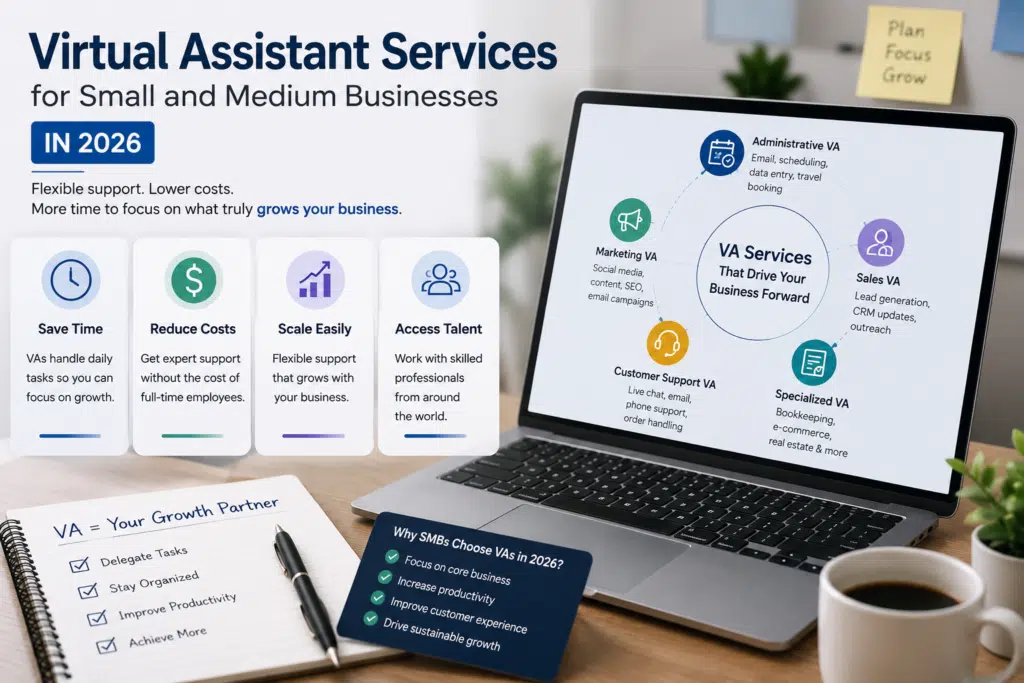
What Are Different Types of Virtual Assistant Services for Small and Medium Businesses?
The term “virtual assistant” used to mean one thing: someone who managed your calendar and inbox. But it is no longer limited to that today. In 2026, VA services span a much wider range of business functions, and many VAs now work alongside AI tools to handle higher-value tasks than before.
Here’s a breakdown of the main categories:
| Type of Virtual Assistant | Common Responsibilities |
| Administrative Virtual Assistant | Scheduling, inbox management, data entry, travel booking, document prep |
| Customer Support Virtual Assistant | Live chat, email tickets, phone support, order handling |
| Digital Marketing Virtual Assistant | Social media posting, content writing, email campaigns, basic design, SEO tasks |
| Sales Support Virtual Assistant | Lead generation, CRM updates, outreach sequences, appointment setting |
| Specialized Support Virtual Assistant | Bookkeeping, e-commerce store management, real estate coordination, podcast production |
One notable shift heading into 2026 is that many VA services now bundle AI-assisted workflows like:
- Automated meeting notes
- AI-drafted first-pass content
- CRM enrichment
This means that a single VA can cover more ground than a few years ago. That’s changed how businesses think about staffing, and it’s part of why demand has grown so much.
Why SMBs Are Turning to Virtual Assistants in 2026
Hiring a virtual admin assistant is all about working smarter now. Small businesses are expected to do more than before, where managing everything yourself eventually becomes unsustainable.
Here’s why business owners are choosing virtual assistants:
- Tighter budgets, same workload: Many businesses are slowing down hiring to control costs, but the workload hasn’t changed. A virtual assistant helps fill the gap without the expense of a full-time employee.
- Remote work: Hiring someone you’ve never met in person is no longer unusual after the global pandemic. Businesses are now comfortable working with remote professionals, making virtual assistants an easy choice.
- More flexible hiring options: You can hire a virtual assistant for startups for just a few hours a week instead of committing to a full-time salary. This gives businesses the flexibility to scale support as their needs change.
- AI boosts productivity: Many VAs now use AI tools to complete tasks like drafting emails, organising data, updating CRMs, and creating first drafts of content. This helps them work faster while delivering more value.
- Less burnout for business owners: Instead of spending hours on emails, scheduling, or data entry, business owners can focus on growing the business, meeting clients, and making important decisions.
Admin vs Marketing vs Sales Virtual Assistants: Which One Do You Hire First?
Every virtual assistant does a different job, and hiring the wrong type first is a common mistake. The right starting point depends on where your time is actually leaking.
Ask yourself: What’s costing you the most hours right now: staying organized, staying visible, or staying in front of leads? Your answer will point you towards the right type of VA for your business.
Here’s a brief comparison table to evaluate your options virtual admin assistant
| Basis | Admin VA | Marketing VA | Sales VA |
| Core tasks | Email management, calendar, scheduling, data entry, travel booking | Social media management, content drafts, email campaigns, basic design | Lead generation, CRM updates, cold outreach, appointment setting |
| Best for | Business owners overwhelmed by daily admin work | Businesses needing consistent visibility and marketing | Businesses with a steady flow of leads but no time to manage them all |
| When to Hire | You’re spending too much time on emails, scheduling, and paperwork | Your marketing has become inconsistent, or you’re struggling to stay visible online. | Leads are not being followed up, and your team is spending more time on admin work. |
| Time to value | Fast (within days) | Medium (2-6 weeks) | Medium to slow (2-8 weeks) |
| Typical hourly range | $8-$20/hr | $12-$30/hr | $12-$40/hr |
Most SMBs eventually use a mix, but starting with the role tied to your biggest bottleneck gives you the clearest, fastest ROI.
How Much Do Virtual Assistant Services Cost for SMBs?
VA pricing varies widely based on skill level, location, and how you structure the engagement.
Common pricing models:
- Hourly: Pay only for time worked; most flexible for testing the waters.
- Retainer: A fixed monthly rate for a set number of hours; better for ongoing needs.
- Task-Based/Project Pricing: Flat fee per deliverable (e.g., “$50 per blog post”)
- Platform Subscription: A monthly fee to a VA service company that manages staffing for you.
Typical price ranges:
| VA Type | Offshore (e.g., Dominican Republic, LATAM) | Domestic (US/UK/AU) |
| Junior Admin VA | $6-$12/hr | $20-$30/hr |
| Experienced Admin VA | $12-$18/hr | $30-$45/hr |
| Marketing VA | $10-$25/hr | $35-$60/hr |
| Sales VA | $12-$25/hr | $35-$65/hr |
| Specialized (bookkeeping, e-comm) | $15-$30/hr | $40-$75/hr |
Note: These are estimated market rates and can vary based on experience, skills, industry, and the scope of work.
Hidden costs to watch for:
- Onboarding and training time (yours and theirs)
- Software/tool licenses you need to provide access to
- Management overhead because someone still needs to review the work
- Platform fees if you’re using an agency rather than hiring directly
Virtual Assistant vs In-House Employee: Which Is Better?
Many business owners struggle with this decision. Should you hire an employee or outsource the work to a virtual administrative assistant service? The answer depends on your workload and business goals.
| Virtual Assistant | In-House Employee |
| Flexible working hours | Fixed working schedule |
| Pay only for the hours you need | Monthly salary regardless of workload |
| Quick hiring process | Longer recruitment process |
| No office space required | Office space and equipment may be needed |
| Easy to scale up or down | Harder to adjust staffing levels |
For businesses with ongoing, full-time responsibilities that require someone to be physically present, an in-house employee may be the better choice. However, if you need flexible support for recurring tasks, a virtual assistant is often the more practical and cost-effective option.
How to Hire the Right Virtual Assistant for Your Business?
Hiring a VA is less about finding “the best one” and more about setting up a process that filters out mismatches early. Here’s the step-by-step process:
Step 1: Define the Outcome
Instead of saying, “I need 10 hours a week,” define what you want to achieve after those 10 hours. For example:
- Inbox is at zero daily.
- 20 qualified leads added to the CRM every week.
Step 2: Choose Your Hiring Channel
You can hire a virtual assistant for digital marketing through:
- VA-specific platforms
- General freelance marketplaces
- Staffing agencies
- Independent referrals
Agencies cost more but handle vetting and replacements, while independent hires are usually more affordable but require more due diligence from you.
Step 3: Evaluate Skills and Availability
Vet candidates based on skills, communication, and time zone overlap. A technically skilled VA who’s unreachable during your work hours creates more friction than value.
Step 4: Start with a Paid Trial Task
Run a small, paid task before making a long-term commitment. A real task (not a hypothetical interview question) tells you more about the candidate’s fit than any resume.
Step 5: Set Up Tools and SOPs
Prepare your processes before handing over work. Use:
- Loom videos
- Shared documents
- Project management tools like Trello, Asana, or ClickUp
These make delegation much smoother.
Things to Keep in Mind:
- Vague answers about past work or unwillingness to share references
- No clarifying questions asked about your business during the interview
- Overpromising availability across too many time zones or too many clients at once
- Refusal to do a paid trial task
Getting the first 30 days right with clear expectations, a real trial run, and documented processes is what separates SMBs who get lasting value from VAs and those who churn through hires every few months.
Common Mistakes to Avoid When Hiring a Virtual Assistant
No doubt, a virtual assistant can help you save time and improve productivity, but only if you set them up for success. Here are a few common mistakes to avoid: Avoid these common mistakes:
- Hiring before defining your tasks
- Expecting one person to handle every business function
- Giving unclear instructions
- Skipping onboarding
- Failing to provide regular feedback
Treat your virtual assistant like a valuable member of your team, even if they work remotely.
Conclusion
The best virtual assistant services for small and medium businesses are about helping businesses work more efficiently.
Whether you choose an administrative virtual assistant to manage daily operations, a digital marketing virtual assistant to strengthen your online presence, or a sales virtual assistant to support lead generation, the goal is the same: giving you more time to focus on growing your business.
Start by identifying the tasks that slow you down the most. Then hire a virtual assistant with the skills to handle those responsibilities. As your business grows, you can expand your support and build a more efficient team without the overhead of hiring multiple full-time employees.
The right virtual assistant doesn’t just complete tasks; they help create the time and space you need to move your business forward!
FAQs
Q1. Is it safe to give a virtual assistant access to confidential business information?
Yes, it is completely safe to give a virtual assistant access to confidential business information, provided that you follow good security practices. Make sure to use role-based permissions, password managers, and non-disclosure agreements wherever necessary. Giving access only to the specific tools and information they need helps protect sensitive business data.
Q2. Should a small business hire a virtual assistant or use a call centre?
Well, the answer depends completely on your needs. A virtual assistant is ideal for personalized administrative, marketing, and sales support. Call centre companies, on the other hand, are better suited for managing high volumes of customer calls. Some growing businesses use both to balance efficiency with personalised advice.
Q3. Can a virtual assistant use my existing business tools?
Yes, most experienced virtual assistants with AI already work with platforms like Google Workspace, Microsoft 365, Slack, Zoom, Trello, Asana, ClickUp, HubSpot, Salesforce, and more. Before hiring, make sure to confirm that they’re comfortable with the tools your business already uses.
Q4. What tasks should you avoid assigning to a virtual assistant?
Virtual assistants are ideal for repetitive and process-driven tasks, but they should not be responsible for major business decisions, confidential legal matters, or tasks that require executive authority. It is best to keep strategic planning and final approvals in-house.
Q5. Should you hire one full-time virtual assistant or several specialists?
The choice between hiring one full-time virtual assistant or several specialists depends on your workload. A general virtual assistant is usually enough for administrative support, while businesses with growing marketing or sales needs often achieve better results by hiring specialists for each function.