
Every sales team wants the same thing: more qualified leads and more closed deals. The challenge is getting there without burning through time or budget. That’s why many businesses are now asking whether AI can do the job just as well as a traditional outsourced sales team.
So, which option delivers better results?
The answer isn’t as simple as choosing AI or people. The right choice depends on your budget, sales process, customers, and business goals. In many cases, the best results come from using both together.
This guide compares AI sales outsourcing with traditional B2B sales outsourcing across cost, speed, lead quality, and ROI, to help you decide which approach works best for your business.
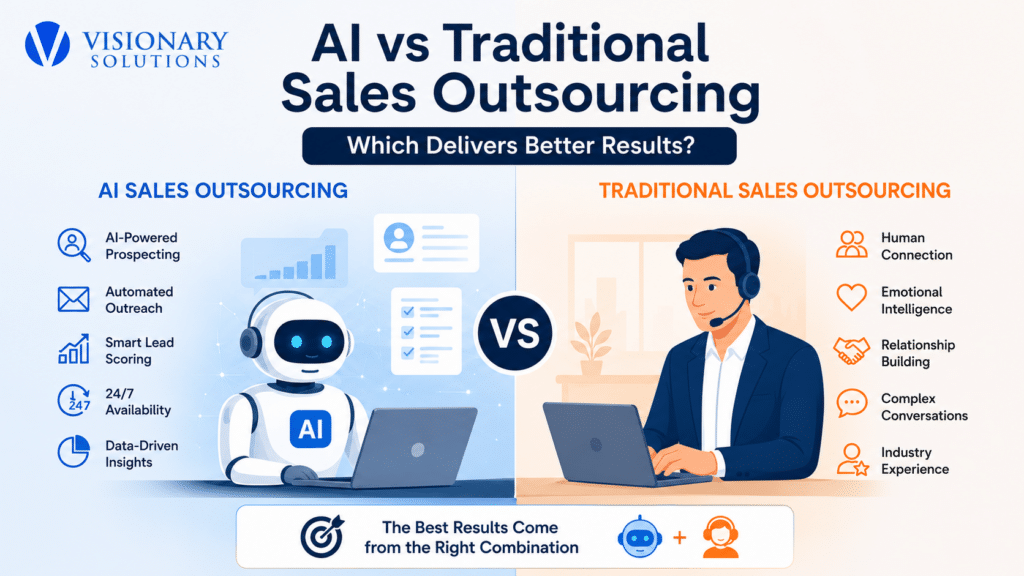
AI sales outsourcing uses artificial intelligence to handle parts of the sales process that usually take up a lot of time. Instead of relying only on people, businesses use AI-powered tools to automate repetitive tasks.
These tools can:
- Find potential customers
- Score and rank leads
- Send personalized email sequences
- Make calls
- Schedule meetings
- Follow up with prospects
- Analyze customer data and rank prospects by likelihood to convert
To give you an example, an AI Sales Development Representative (AI SDR) can contact hundreds of prospects in a day, something that would take a human sales rep much longer.
Popular AI Sales Agents in the Industry
AI sales agents are designed to work more like digital members of a sales team rather than traditional software tools. Here are some of the top names in the industry:
- Ava — Artisan: Artisan’s autonomous AI BDR handles outbound sales from prospect research and personalized outreach to reply handling and meeting booking.
- Alice — 11x: Alice is 11x’s AI SDR, built to track buying signals, research prospects, personalize outreach, handle replies, and book meetings around the clock.
- Piper — Qualified: Piper is Qualified’s AI-powered sales agent, designed to engage website visitors, qualify prospects, and help route high-intent buyers to sales teams.
- Fin — Intercom: Fin is Intercom’s AI agent that now supports multiple customer-facing roles, including sales. In sales mode, it can engage inbound buyers, qualify them, and book meetings.
- Duo — Amplemarket: Duo Copilot uses multiple AI agents across signals, research, and outreach. It identifies buying signals, researches prospects, and creates personalized multichannel sequences for sales reps.
Where AI Works Best
AI is especially useful when businesses need to:
- Reach large numbers of prospects quickly
- Respond to leads faster
- Reduce manual work
- Improve lead qualification
- Keep outreach running 24/7
However, AI still depends on quality data and clear instructions. It cannot replace human judgment in every sales situation.
What is Traditional Sales Outsourcing?
Traditional sales outsourcing refers to hiring a sales outsourcing company to run a part or all of your sales operations using human reps. These teams may handle:
- Prospecting
- Cold calling
- Appointment setting
- Lead qualification
- Inside sales
- Customer follow-ups
Many companies also outsource sales reps to expand into new markets without hiring full-time employees.
Where Human Sales Teams Help
People bring skills that AI still struggles to match. Traditional sales focus on building authentic relationships through personal interactions, emotional intelligence, and cultural understanding. Professionals manually research prospects, craft individualized messages, and rely on experience to guide strategic decisions throughout the sales process. This is why many businesses still continue to invest in inside sales outsourcing, especially for high-value B2B sales
AI Sales Outsourcing vs. Traditional Sales Outsourcing: Comparison Table
The biggest differences become clear when you compare them side by side.
| Factor | AI Sales Outsourcing | Traditional Sales Outsourcing |
| Cost Structure | Costs more to set up initially but each additional lead costs very little once the system is running. | Costs less to start but fees grow steadily as you add more reps. |
| Scalability | Can easily scale up or down instantly with no hiring required. | Scaling up requires hiring and training additional reps. |
| Availability | Works around the clock and across all time zones. | Only available during business hours unless reps are working in different shifts. |
| Speed to Lead | Replies to new leads instantly. | Typically replies within minutes to a few hours, depending on staffing. |
| Personalization | Uses templates and rules, so responses may feel similar across leads. | Adapts tone and content in real time based on the conversation. |
| Handling Objections | Handles common and predictable objections well. | Handles complex and unexpected objections better. |
| Consistency | Delivers the same message and process every time, maintaining quality control. | Quality can vary by salesperson, their experience level, and how their day is going. |
| Best for Which Deal Size | Works best for lower-ticket, high-volume, transactional sales. | Works best for high-ticket, complex, relationship-driven sales. |
| Best for Which Sales Cycles | Works best for short sales cycles. | Works best for long, multi-touch sales cycles. |
| Management Overhead | Needs someone internally (e.g., RevOps or marketing) to monitor and refine it | Mostly managed by the outsourcing partner for you. |
| Compliance Adherence | Driven by volume and cost efficiency at scale. | Driven by conversion quality on complex deals. |
Neither option is better in every situation. Each solves different business challenges.
Cost Comparison: Upfront Investment vs Ongoing Service Fees
Cost is often one of the biggest deciding factors. Let’s help you decide:
AI Sales Outsourcing Costs
AI sales outsourcing services tend to have a different cost based on factors like:
- Integration with your current CRM
- Building outreach sequences
- Training the AI on your ICP (Ideal Customer Profile)
Once everything is running, AI can handle thousands of tasks without significantly increasing costs. This makes it attractive for businesses that need large-scale outreach.
Traditional Sales Outsourcing Costs
With sales outsourcing services, businesses typically pay:
- Monthly service fees
- Per-representative pricing
- Performance-based commissions
- Campaign management costs
There’s also ramp time to factor in, since new reps usually take 4-6 weeks to hit full productivity after getting training. You are paying during that ramp time regardless of the output.
A Quick Cost Comparison
| Cost Factor | AI Sales Outsourcing | Traditional Sales Outsourcing |
| Typical monthly cost | $100-$1,000+ | $2,000-$10,000+ |
| Setup time | Low to moderate | Usually handled by provider |
| Management required | Internal oversight | Mostly managed by provider |
| Best for | High-volume outreach | Relationship-driven B2B sales |
Actual costs vary depending on the platform, provider, team size, and business requirements.
Which Option Gives You More Value for Your Money?
For companies exploring outsourcing sales for small businesses, this is important because if your monthly lead volume is lower, the setup cost of an AI system may not pay off as quickly as a traditional outsourced sales team would.
There is another thing people often overlook: who is going to manage everything?
With a traditional outsourced team, you usually get an account manager who handles everyday work and updates you. Working with AI is different. Someone still needs to check that it’s working properly, update the messaging, and make changes. That takes time and money both.
Which is Faster and Easier to Scale: AI or Traditional Sales Outsourcing?
One of AI’s biggest advantages is speed. This is where AI has a structural advantage that is hard to argue with.
A human outsourced sales team is limited by headcount and working hours. Even an experienced sales outsourcing company can only make so many calls or send so many messages per rep per day. Plus, the coverage stops outside of business hours. This is a real limitation if your buyers are in different time zones.
AI sales outsourcing runs 24/7 without fatigue. It can:
- Respond to an inbound lead in seconds
- Scale outreach volume up or down instantly
- Handle traffic spikes without needing to hire and train new staff
Which Delivers Better Lead Quality: AI or Human Sales Teams?
Finding leads is only part of the sales process. Turning those leads into customers is what really matters.
AI is Great at Finding Patterns
AI sales outsourcing is strong at volume and consistency. It never has a bad day and applies scoring logic evenly across every lead. But personalization is usually missing. It is improving fast, but for now it’s better suited to top-of-funnel qualification than high-stakes closing conversations.
Humans Create Better Connections
Human reps read tone, adapt mid-conversation, handle unexpected objections, and build rapport in ways that still outperform most AI systems today. For enterprise deals, long sales cycles, or industries where trust is the deciding factor, a skilled sales professional often converts better than an automated message.
Why the Hybrid Sales Outsourcing Model Often Works Best?
Instead of choosing one over the other, many businesses now combine AI with human sales professionals. In a hybrid model:
- AI finds and scores leads.
- AI automates routine follow-ups.
- Human SDRs qualify opportunities.
- Sales reps handle meetings and negotiations.
- Account managers build lasting customer relationships.
A hybrid outsourcing sales model allows businesses to save time without losing the human connection that drives sales. A hybrid strategy also helps sales teams focus on what they do best. AI handles repetitive work, while people spend more time having meaningful conversations with qualified prospects.
How to Choose the Right Sales Outsourcing Model for Your Business?
A SaaS startup generating 5,000 inbound leads each month may benefit from AI because manually qualifying every lead isn’t practical. On the other hand, a cybersecurity company selling six-figure enterprise contracts is more likely to rely on experienced sales professionals to build trust and guide buyers through a longer decision-making process.
Ask yourself these questions before making a decision:
- What’s your average deal size?
Smaller, transactional deals tend to lean toward AI, since the sales process is more standardized and doesn’t require heavy relationship-building. Larger, more complex deals tend to lean toward human reps, who can navigate stakeholders and negotiate terms.
- How long is your sales cycle?
Short cycles benefit from AI’s speed-to-lead and always-on follow-up. Long, multi-touch cycles benefit more from a human rep who can build trust and stay engaged with the buyer over weeks or months.
- What’s your lead volume?
High lead volume favors AI, since its cost per lead drops as volume grows. Lower lead volume may not generate enough to justify the upfront cost of setting up an AI system.
- How complex are your buyer conversations?
Simple, standardized pitches with predictable objections are well suited to AI. Negotiations involving multiple decision-makers or custom pricing are better handled by an experienced human rep.
- What’s your budget flexibility?
Traditional outsourcing comes with predictable, ongoing monthly costs that are easy to budget for. AI sales outsourcing usually requires a larger upfront investment but becomes cheaper per lead over time, which suits businesses that can absorb setup costs now in exchange for lower costs later.
There’s no single best sales outsourcing model for small business or enterprise. The right choice depends on where your leads come from, how complex your deals are, and how much of the process genuinely benefits from automation versus human judgment.
Final Thoughts
AI is transforming the way businesses find and engage prospects. It makes outreach faster, improves lead qualification, and helps sales teams work more efficiently. But it still cannot fully replace the trust, empathy, and problem-solving skills that experienced sales professionals bring to every conversation.
Instead of asking whether AI or humans are better, ask how each can strengthen your sales strategy.
For many businesses, the smartest investment is a balanced approach that combines AI with experienced professionals. By blending technology with skilled sales teams, companies can improve efficiency while still delivering the personal experience customers expect.
If you’re exploring B2B sales outsourcing or looking for flexible sales outsourcing services, Visionary Solutions Inc. can help you build a strategy that fits your goals. Whether you need AI-supported outreach, experienced SDRs, or a hybrid model, the right approach can help you generate better leads, stronger relationships, and sustainable business growth.
FAQs
Q1. Does AI sales outsourcing work for businesses with a small sales team?
Yes, small sales teams often benefit the most because AI helps them do more without hiring additional staff. It can handle tasks like prospect research, email outreach, and lead qualification, allowing a small team to manage a much larger sales pipeline.
Q2. What industries benefit from AI sales outsourcing?
AI sales outsourcing works well in industries that rely on high-volume lead generation, such as SaaS, IT services, e-commerce, digital marketing, and business consulting. Businesses with a large audience and shorter sales cycles often see the greatest improvements in productivity and response times.
Q3. Can AI help improve the performance of an outsourced sales team?
Yes, AI can make outsourced sales teams more productive by identifying high-quality leads, automating follow-ups, and providing insights into customer behaviour. This allows sales reps to spend less time on admin work and more time converting those leads.
Q4. Should businesses switch from traditional sales outsourcing to a hybrid model?
Absolutely, many businesses start by introducing AI into one part of their sales process, such as lead generation or email outreach, while keeping human sales representatives responsible for meetings and closing deals. This gradual approach allows teams to adopt new technology without disrupting existing workflows.
Q5. What should you look for in a sales outsourcing company?
It is important to choose a partner that has experience in your industry and provides transparent reporting, scalable services, and a proven sales process. It’s also important to ensure they can adapt and customize their approach as your business grows.