
No, most small businesses shouldn’t fully replace customer support agents with AI. The businesses seeing the best results in 2026 use AI to handle repetitive, high-volume requests (FAQs, order status, scheduling) while keeping trained human agents for complaints, sales conversations, and anything emotionally sensitive. Many are getting both without the hiring headache by working with an outsourced support partner that already blends the two.
AI vs Human Agents: Side-by-Side
| AI Customer Service | Human Agents | |
|---|---|---|
| Availability | 24/7, instant | Limited to shift hours |
| Cost at scale | Low per-interaction cost | Higher (salary, benefits, turnover) |
| Handles repetitive queries | Excellent | Overkill, wastes their time |
| Handles complaints/emotion | Weak — can’t read tone or de-escalate | Strong |
| Sales & negotiation | Poor | Strong |
| Setup time | Fast once trained | Weeks to months to hire and onboard |
| Customer trust for high-stakes issues | Lower | Higher |
Where AI Actually Wins
AI customer service tools have gotten very good at narrow, repeatable tasks — password resets, order tracking, appointment booking, basic troubleshooting, and after-hours coverage. A bot doesn’t get tired at 11 p.m. and doesn’t need a break between the 40th and 41st “where’s my order” message.
If your support inbox is 70% the same five questions, AI is the obvious first move. It also shines at first response — even when a query eventually needs a human, AI can acknowledge the customer instantly and hand off a fully-loaded ticket instead of making them explain the problem twice.
This matters most for small teams that can’t staff every hour a customer might reach out. A solo founder or five-person team can’t be online at 2 a.m. — AI can, buying coverage they couldn’t otherwise afford.
Where Human Agents Still Win
The moment a query gets emotional, ambiguous, or high-stakes, AI starts to struggle. A customer who’s had a shipment delayed three times isn’t looking for a perfectly worded apology — they want someone who can actually solve the problem and sound like they mean it.
This is also where revenue-driving conversations live. Upsells, renewals, and retention calls depend on reading a customer’s tone and adjusting in real time — something scripted automation still can’t reliably do. It’s why the strongest support setups pair automation with trained people across sales, support, and back-office functions, rather than betting everything on one or the other.
There’s a trust dimension too. Customers dealing with billing disputes or cancellations escalate fast if they feel like they’re talking to a wall. A human who says “I see exactly what happened, let me fix this” builds loyalty a bot’s polished apology rarely does — often worth more than the few dollars saved by automating it.
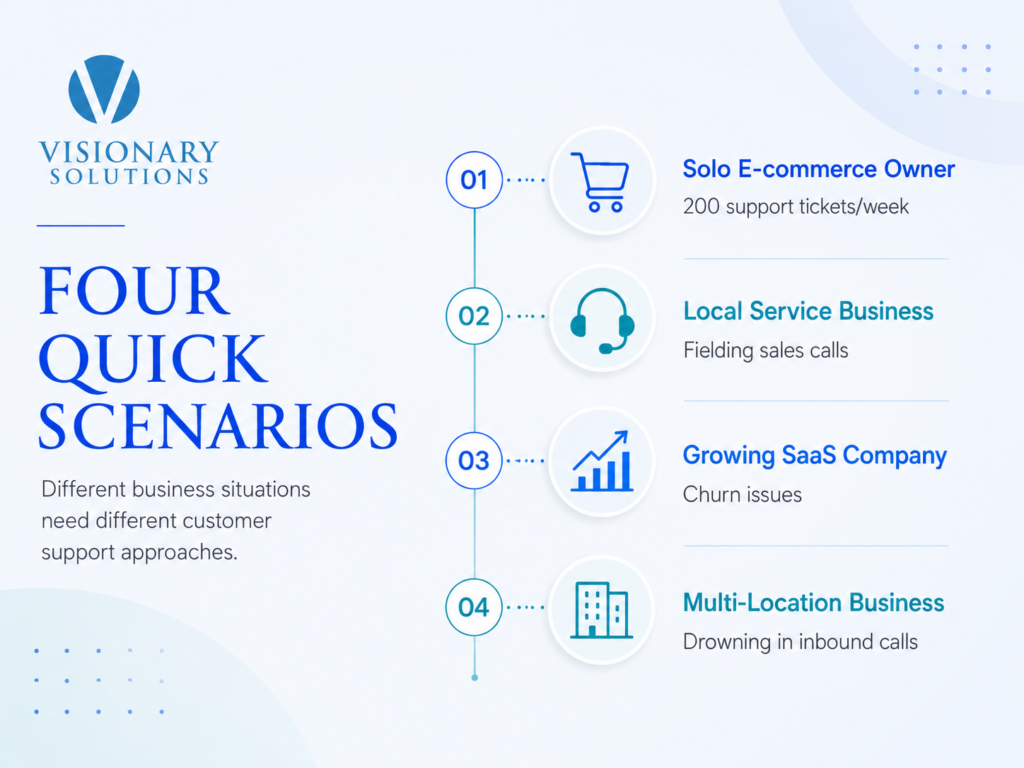
Four Quick Scenarios
Scenario 1: Solo e-commerce owner, 200 support tickets/week. Mostly shipping and return questions. AI chatbot handles 80% instantly; a small human team (or a virtual assistant) covers escalations. Low cost, fast response times.
Scenario 2: Local service business fielding sales calls. Callers want pricing, comparisons, and reassurance — not a bot. This is a case for trained sales outsourcing or an in-house rep, not automation.
Scenario 3: Growing SaaS company with churn issues. Retention conversations need empathy and judgment calls AI can’t make. Automate the onboarding FAQs; keep humans on renewal and complaint calls.
Scenario 4: Multi-location business drowning in inbound calls. Every location is fielding its own calls with no consistency, and hold times are climbing. Rather than hiring a receptionist per location, this is where inbound call center services or a centralized outsourcing call center make the most sense — one trained team handles every location’s calls with the same quality bar, and AI routing sorts simple requests from ones that need a live rep.
The Real Cost Math
Building an in-house team from scratch means job postings, interviews, training, software, management, and turnover — often the single biggest hidden cost in customer support. AI tools cut the per-ticket cost dramatically but still need human oversight, quality checks, and an escalation path for anything they can’t handle.
Most small businesses don’t actually save money by picking one extreme. They save money by right-sizing: automate what’s repeatable, staff what’s not, and avoid the overhead of building either system entirely from scratch. This is exactly the gap that BPO outsourcing and call center outsourcing partners are built to close — you get trained agents and AI-assisted tools already running together, without hiring a department.
Break the “true cost” of each option into what actually shows up on a budget:
- Fully in-house team: recruiting fees, salaries, benefits, management time, software, training, and the cost of turnover when an agent leaves after eight months.
- AI-only setup: lower cost per ticket, but you still pay for the platform, integration, and ongoing maintenance — plus you still need a human safety net for anything the bot mishandles.
- Outsourced blended model: a flat or usage-based fee that already includes trained agents, management, and AI-assisted tooling, with no hiring or turnover risk on your plate.
For a small business without an HR department, that third option is often the least operationally painful — not necessarily the cheapest line item, but the one that removes management overhead entirely.
A Faster Path: Outsourcing Instead of Building In-House
This is the part most “AI vs human” articles skip. You don’t have to choose between coding your own chatbot and hiring a full internal team. A sales outsourcing company or customer support outsourcing partner already has both the technology and the trained staff in place.
A few ways small businesses typically plug in:
- Inbound support: An outsourcing call center or call center service provider handles day-to-day tickets and inbound calls without you managing a floor of agents.
- Revenue growth: A b2b sales outsourcing company covering lead generation outsourcing, inside sales outsourcing, and full outsourced sales reps for businesses that need pipeline, not just support.
- Admin overflow: A sales virtual assistant or administrative virtual assistant absorbs scheduling, CRM updates, and follow-ups — even a digital marketing virtual assistant role for smaller marketing tasks.
- Back office: Billing, document processing, and email management handled through back office outsourcing, freeing your core team for higher-value work.
If you’re comparing outsourcing companies in USA or bpo companies in usa, the ones worth a call are the ones already running AI-assisted tools and live agents side by side — not one or the other.
How to Actually Roll This Out
If you’ve decided a blended approach makes sense, the rollout doesn’t need to be complicated:
- Audit your last 200 tickets or calls. Tag each one as repeatable/simple or complex/emotional. This single exercise usually makes the AI-vs-human split obvious within an hour.
- Automate the top 3–5 repeat categories first. Don’t try to automate everything on day one — start with the highest-volume, lowest-risk queries and expand from there.
- Set clear escalation rules. Define exactly when AI should hand off to a human — a frustrated tone, a refund request, a third repeated question — so customers never feel stuck in a loop.
- Decide build vs. partner. If you don’t have months to hire, train, and manage a team, evaluate a sales outsourcing company or customer support outsourcing company that already runs both sides of this system.
- Review monthly. Ticket patterns shift as your business grows, so what’s “automatable” today may need a human touch in six months, and vice versa.
FAQs
Should I replace customer support agents with AI?
No — replace the repetitive parts of their workload with AI, not the agents themselves. Keep humans for complaints, sales, and anything emotionally sensitive.
Is AI Going to Replace Customer Support?
No. AI will handle simple and repetitive tasks, but human agents will still be needed for complex problems, complaints and personal support.
Will AI Get Rid of Call Centres?
No. Call centres will become AI-assisted contact centres, where AI handles routine calls and humans manage difficult or sensitive issues.
What Is the Future of AI in Customer Support?
AI will make customer support faster, more personalized and available 24/7. The best model will combine AI tools with trained human agents.
The winning approach isn’t “AI vs. humans” — it’s AI and humans, sized correctly for your actual ticket volume and deployed through whichever route gets you there fastest. For most small businesses, that means automating the predictable and outsourcing the rest, rather than trying to build a full department from zero.