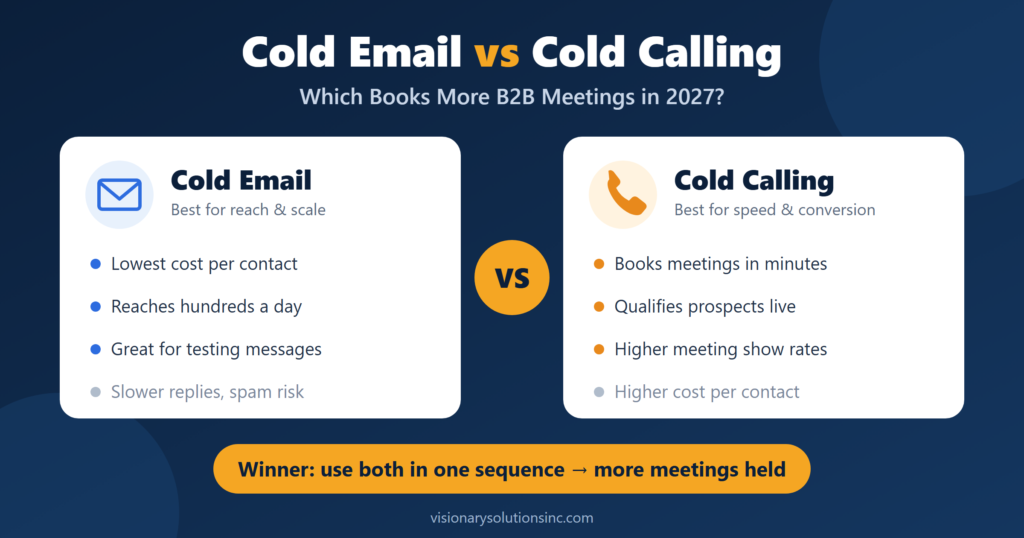
Cold email usually provides greater reach at a lower cost per account, while cold calling provides faster feedback and a better opportunity to qualify complex or high-value sales opportunities. The better channel depends on your average contract value, target market, offer complexity and ability to reach decision-makers. Many B2B companies use both: email creates context and phone conversations turn relevant interest into qualified meetings.
The goal is not to generate the most opens or make the most dials. It is to create sales-accepted meetings, qualified opportunities and pipeline at a sustainable cost.
Key Takeaways
- Cold email is useful when you need to reach a large, well-defined market efficiently.
- Cold calling is useful when the offer is valuable, complex or easier to explain through conversation.
- Email provides a written message that prospects can review or forward to other members of the buying committee.
- Calling provides immediate feedback about a prospect’s needs, authority, timing and objections.
- A coordinated sequence can use email to create familiarity and calls to qualify priority accounts.
- Measure meetings held, opportunities created and pipeline generated instead of relying on opens, sends or dial volume.
Cold Email vs Cold Calling at a Glance
| Factor | Cold email | Cold calling |
| Best suited for | Reaching a large target-account list | Engaging high-priority or high-value accounts |
| Speed of feedback | Usually slower | Immediate when the prospect answers |
| Scalability | High, if data and deliverability are managed properly | Limited by available calling capacity |
| Personalization | Based on account and buyer research | Can adapt during the live conversation |
| Qualification | Usually requires several exchanges | Questions can be answered during the call |
| Ability to involve other stakeholders | Easy to forward internally | Requires follow-up and additional conversations |
| Main operational dependency | Data quality and email deliverability | Contact data, connect rates and caller quality |
| Most useful metric | Positive replies and qualified opportunities | Conversations, meetings held and qualified opportunities |
| Common failure | Sending generic messages at excessive volume | Prioritizing dial volume over relevant conversations |
Neither channel is automatically better. The right decision depends on how your company sells and what must happen before a prospect becomes a qualified opportunity.
What Is B2B Cold Email?
B2B cold email is a commercial email sent to a relevant business prospect who has not previously requested contact. Its purpose is usually to start a conversation, confirm interest or schedule a discovery meeting.
A good cold email is not a mass newsletter. It should be based on a defined ideal customer profile and address a problem that is relevant to the recipient’s role or company.
Cold email is also different from traditional email marketing. Email marketing usually includes newsletters, lead-nurture campaigns, product announcements and customer-retention messages sent to an existing audience. Cold email is outbound prospecting directed at new accounts.
Businesses that need nurture campaigns for existing leads can explore VSI’s B2B email marketing services.
What Is B2B Cold Calling?
B2B cold calling is direct telephone outreach to a potential business customer who has not requested a call. The objective is normally to determine whether the company and contact are relevant, understand the business problem and schedule an appropriate next conversation.
Cold calls are commonly handled by sales development representatives, business development representatives or B2B appointment setters. The representative should not attempt to force a complete sale during the opening call. The more practical objective is to earn enough interest for a qualified next step.
Which Channel Should Your B2B Company Use?
Evaluate four factors before deciding where to invest.
1. Average Contract Value
Calling is easier to justify when a single successful deal has enough value to support the additional research and representative time. A live conversation can also be important when the prospect needs to understand implementation, risk, pricing or operational impact.
Email may be more economical when the offer has a lower contract value and the company needs to contact a much larger number of accounts.
2. Total Addressable Market
If your target market contains a few hundred strategic accounts, high-volume email can waste opportunities and create unnecessary brand risk. Those accounts may require individual research, multiple contacts and carefully planned calls.
If your market contains thousands of relevant companies, email can help identify which segments and messages produce interest before assigning callers to the most promising accounts.
3. Offer Complexity
A simple product with an obvious use case may be understandable in a short email. Outsourcing, software implementation, professional services, financial products and other complex offers often generate questions that are easier to address in conversation.
4. Buyer Accessibility
Some business owners and operational leaders regularly answer calls. Other buyers, particularly senior enterprise and technical professionals, may screen unknown numbers but still review a relevant email.
Use your own CRM data to determine how prospects in each segment prefer to respond. Do not assume that every role or industry behaves the same way.
A Practical B2B Decision Framework
| B2B sales situation | Recommended starting approach |
| High contract value and a limited account list | Research-led calling supported by personalized email |
| Complex service with several decision-makers | Coordinated email, calling and account-based follow-up |
| Large market with a relatively simple offer | Email-led outreach with calls to priority or engaged accounts |
| Owner-led small and midsize businesses | Test calling and email, then compare qualified-opportunity costs |
| Warm leads or previous inquiries | Rapid phone follow-up supported by email confirmation |
| Enterprise named accounts | Multi-contact outreach customized for the buying committee |
When Cold Email Is the Better Starting Channel
Cold email may be a practical starting point when:
- Your ideal customer profile includes thousands of potential accounts.
- The value proposition can be understood without a lengthy explanation.
- Prospects need written information they can share with colleagues.
- You want to test industries, pain points or messages before adding calling capacity.
- Your buyers are difficult to reach through unknown phone numbers.
- Your sales cycle requires contact with several people at the same company.
Email still requires operational discipline. Poor lists, excessive volume and weak authentication can harm deliverability before the company learns anything useful.
Google recommends that senders configure email authentication and monitor domain reputation. All senders to Gmail need SPF or DKIM, while bulk senders face additional requirements including SPF, DKIM and DMARC. Review the current Gmail sender guidelines before launching a campaign.
When Cold Calling Is the Better Starting Channel
Cold calling may deserve more investment when:
- Your average contract value can justify representative time.
- The offer is complex and prospects typically have several questions.
- The sales team needs market feedback quickly.
- Prospects have already shown meaningful intent, such as requesting information or replying to outreach.
- The target market includes owner-led or operationally focused businesses.
- Timing matters and the company needs to qualify opportunities without waiting through a long email sequence.
Calling is not automatically successful because it is more direct. Results still depend on account selection, contact accuracy, caller training, message relevance and the quality of the discovery questions.
Should You Email or Call First?
For many B2B campaigns, a brief email followed by a call is a reasonable sequence to test. The email gives the prospect context, while the call creates an opportunity for a direct conversation.
However, the order should reflect the account tier:
- Tier 1 accounts: Research the account, contact the most relevant stakeholder and use coordinated phone and email outreach.
- Tier 2 accounts: Use a semi-personalized email followed by a call based on role and account fit.
- Tier 3 accounts: Use a carefully controlled email-led test before allocating significant calling time.
An email open by itself should not be treated as buying intent. Email-open data can be affected by privacy and security technologies. Prioritize stronger signals such as replies, relevant link activity, form submissions, event attendance and previous conversations.
Example Multichannel B2B Outreach Sequence
The following is a starting framework, not a universal formula. Adjust the timing and number of touches according to the buyer, sales cycle and applicable marketing rules.
- Day 1 – Personalized email: Identify one relevant business problem and explain why the conversation may be useful.
- Day 2 or 3 – Call: Mention the reason for the outreach and ask a short qualification question.
- Day 4 – Voicemail when appropriate: Leave a brief message that adds context rather than repeating the email.
- Day 6 – Follow-up email: Share a relevant example, insight or short case study.
- Day 9 – Second call: Try a different time of day and focus on a different business question.
- Day 12 – Additional stakeholder or professional-network touch: Contact another relevant member of the buying committee when appropriate.
- Day 15 – Close-the-loop email: Politely acknowledge that the priority or timing may not be right and provide a useful way to reconnect.
Once a prospect responds, stop the automated sequence and handle the conversation personally. Repeating automated touches after a reply can damage trust.
How to Measure Cold Email and Cold Calling
Do not compare email and calling using activity metrics alone. A campaign that produces more meetings may still perform poorly if the accounts are unqualified or the meetings never progress.
Cold Email Metrics
- Delivery and bounce rate
- Positive reply rate
- Qualified-reply rate
- Meetings booked
- Meetings held
- Opportunities created
Open rate can be monitored directionally, but it should not be treated as a reliable measure of buying interest.
Cold Calling Metrics
- Contact accuracy
- Connect rate
- Decision-maker conversations
- Conversation-to-meeting rate
- Meetings held
- Sales-accepted meetings
- Opportunities created
Shared Revenue Metrics
- Cost per meeting held
- Cost per sales-accepted meeting
- Cost per qualified opportunity
- Meeting-to-opportunity rate
- Pipeline generated
- Opportunity-to-customer rate
- Customer acquisition cost
Use these formulas:
Cost per meeting held = total campaign cost / meetings that occurred
Cost per qualified opportunity = total campaign cost / qualified opportunities created
Pipeline efficiency = qualified pipeline value / total campaign cost
VSI’s guide to sales outsourcing KPIs provides additional metrics for evaluating an outsourced program.
Illustrative Cost Comparison
The numbers below are hypothetical and are not industry benchmarks or performance promises. They demonstrate why B2B companies should evaluate opportunity quality instead of choosing a channel based only on cost per contact.
| Metric | Email-led campaign | Calling-led campaign | Coordinated campaign |
| Total campaign cost | $3,000 | $6,000 | $8,000 |
| Meetings booked | 24 | 30 | 50 |
| Meetings held | 16 | 24 | 40 |
| Sales-accepted meetings | 8 | 16 | 28 |
| Qualified opportunities | 3 | 8 | 12 |
| Cost per meeting held | $187.50 | $250.00 | $200.00 |
| Cost per qualified opportunity | $1,000.00 | $750.00 | $666.67 |
In this example, email produces the lowest cost per held meeting, but the coordinated campaign produces qualified opportunities at the lowest cost. Actual performance will vary according to the market, offer, data, execution and qualification criteria.
Run the comparison long enough to complete multiple outreach cycles and generate a meaningful sample. For many companies, that may require several weeks rather than a few days.
Common Cold Email Mistakes
- Targeting contacts who do not match the ideal customer profile.
- Sending generic messages that focus on the sender rather than the buyer’s problem.
- Using inaccurate or unverified contact data.
- Increasing sending volume before authentication and reputation are established.
- Failing to configure SPF, DKIM and DMARC appropriately.
- Using misleading subject lines or sender identities.
- Continuing automated outreach after a prospect replies or opts out.
- Measuring opens instead of positive replies, opportunities and pipeline.
Common Cold Calling Mistakes
- Calling broad lists without account or role qualification.
- Reading a rigid script instead of using a structured talk track.
- Pitching before asking relevant questions.
- Optimizing for dials rather than conversations with appropriate decision-makers.
- Failing to test different call times and account segments.
- Recording incomplete outcomes in the CRM.
- Booking meetings without agreed qualification criteria.
- Failing to pass context from the appointment setter to the salesperson.
Mistakes That Affect Both Channels
- No documented ideal customer profile.
- No agreement between marketing, SDRs and sales on what qualifies as a meeting.
- Weak handoff between outreach and the account executive.
- No suppression list for opt-outs and do-not-contact requests.
- No process for feeding sales objections back into campaign messaging.
- Evaluating providers by activity volume instead of opportunities and revenue.
B2B Cold Outreach Compliance
This section provides general information and is not legal advice. Requirements vary by channel, technology, location, recipient and campaign. Obtain legal advice for your specific program.
Cold Email in the United States
The CAN-SPAM Act applies to commercial email, including B2B messages. According to the Federal Trade Commission, senders must use accurate routing information and subject lines, identify commercial messages appropriately, provide a valid postal address, offer a clear opt-out method and honor opt-out requests within 10 business days. A company may also remain legally responsible when another provider sends email on its behalf.
Review the FTC CAN-SPAM compliance guide before launching or outsourcing commercial email.
B2B Calling in the United States
The Telephone Consumer Protection Act and related FCC rules impose restrictions on certain autodialed, prerecorded and artificial-voice calls, particularly calls to mobile numbers. Other federal and state telemarketing, Do Not Call, caller-identification and call-recording rules may also apply.
Manual dialing is not a blanket exemption from every marketing rule. Companies should review their data sources, dialing technology, call purpose, suppression procedures and state requirements with qualified counsel. The FCC provides additional information through its TCPA guidance and orders.
International Outreach
Do not assume that US rules apply to prospects in other countries. Canada, the United Kingdom, the European Union and other jurisdictions have different rules governing electronic marketing and personal information.
For example, UK rules distinguish between corporate subscribers and individual subscribers such as sole traders, while data-protection obligations can apply when a business email address identifies a person. Review the UK Information Commissioner’s B2B marketing guidance and obtain jurisdiction-specific advice.
Should You Build an Internal Team or Outsource Outreach?
An internal outbound team can make sense when prospecting is a long-term core function and the company already has sales leadership, enablement, data and technology in place.
Outsourcing may be useful when the company wants to:
- Launch a structured campaign without recruiting an entire SDR team.
- Add calling or appointment-setting capacity to an existing email program.
- Test a new market before committing to permanent headcount.
- Improve lead follow-up and qualification.
- Add management, training and reporting support.
Outsourcing still requires client involvement. Your company should approve the target market, value proposition, qualification rules, brand voice and handoff process.
Before choosing a partner, ask:
- Are representatives dedicated to our account or shared?
- Who defines and approves the ideal customer profile?
- Who owns the prospect data, scripts, domains and campaign records?
- Which channels are included in the agreement?
- How is a qualified meeting defined?
- Are meetings measured when booked or when held?
- How are no-shows and unqualified meetings handled?
- Which CRM data and call outcomes will we receive?
- How are calls reviewed for quality and compliance?
- Which metrics connect outreach activity to pipeline and revenue?
For a broader explanation, read how sales outsourcing works and VSI’s guide to B2B appointment-setting costs.
How Visionary Solutions Inc. Supports B2B Outreach
Visionary Solutions Inc. provides sales outsourcing support for companies that need additional capacity for lead generation, outbound sales, prospect qualification, follow-up and appointment setting. Campaign scope depends on the target market, sales process and channels agreed upon with the client.
VSI can support businesses that want trained representatives to:
- Contact target accounts by phone.
- Qualify business needs and buyer fit.
- Follow up with prospects and existing leads.
- Schedule qualified meetings for internal sales representatives.
- Maintain outreach activity and outcomes in an agreed workflow.
- Work alongside a client’s internal email or marketing program.
The goal is not to fill a calendar with unqualified appointments. A useful program should define the ideal customer profile, qualification criteria, reporting and sales handoff before outreach begins.
Explore VSI’s sales outsourcing services or discuss a customized B2B appointment-setting program.
Frequently Asked Questions
Is cold email or cold calling better for B2B sales?
Cold email is usually better for reaching a large target-account list efficiently, while cold calling is useful for immediate qualification and complex conversations. The best channel depends on contract value, market size, buyer accessibility and offer complexity. Many B2B teams test a coordinated approach.
Should I send an email before making a cold call?
Sending a brief, relevant email before calling can give the prospect context. However, high-priority accounts may require a more customized sequence, and warm leads may justify calling immediately. Test the order by segment instead of applying one sequence to every account.
Is cold calling still effective for B2B companies?
Cold calling can still be useful when a company has accurate contact data, a well-defined ideal customer profile and trained representatives. Its value is the ability to receive immediate feedback and determine whether a next conversation is appropriate.
Is cold email cheaper than cold calling?
Cold email often has a lower cost per account contacted. It is not necessarily cheaper per qualified opportunity. Data, verification, email infrastructure, campaign management and deliverability all affect the total cost.
How many outbound touches should a B2B sequence include?
There is no universal number. The appropriate sequence depends on account value, buyer role, channel mix, sales cycle and applicable marketing rules. Start with a controlled sequence, review response and complaint data, and adjust based on qualified opportunities rather than activity volume.
What is the best metric for comparing cold email and cold calling?
Cost per qualified opportunity and pipeline generated are usually more informative than opens, dials or meetings booked. Also track meetings held, sales acceptance and opportunity conversion.
Can a company outsource cold calling and appointment setting?
Yes. Businesses can outsource outbound calling, lead qualification and appointment setting instead of recruiting and managing an entire internal team. Confirm how the provider defines a qualified meeting, reports results, protects data and follows applicable marketing rules.
The Bottom Line
Cold email wins on reach. Cold calling wins on live qualification. Neither channel should be judged by volume alone.
For a large target market and a straightforward offer, email may be the more efficient starting point. For high-value or complex B2B services, calling may provide faster learning and better qualification. For many companies, the practical answer is a coordinated program that uses email to create context and phone conversations to develop qualified opportunities.
Measure meetings that occur, opportunities accepted by sales and pipeline created. Those numbers will tell you which channel is actually helping the business grow.
Need more qualified B2B conversations without building an in-house appointment-setting team? Book a free consultation with Visionary Solutions Inc. to discuss your target market, qualification criteria and outreach goals.