
There is no need to blame the marketplace for the stalled pipeline; the culprit is actually the overwhelming workload of your team. There are unmade cold calls, unread follow-ups, and wasted CRM records, responsible for revenue losses of small magnitude, making them potentially detrimental in total. Whatever the case may be, studies indicate that modern employees can dedicate only 34% of their working time to accomplishing real selling tasks. The rest of the time is being spent on routine businesses which might be handled effectively by virtual administrative assistants in a matter of minutes and with a minimum cost.
Most importantly, for more than two decades now, businesses across e-commerce, finance, law, medicine have been turning to dedicated sales agents and administration services. The sales virtual assistant services operate from the Dominican Republic, the same time zone and culture as yours, and they charge you for half the sum compared to what you pay for in-house employees, thus saving on payroll expenses.
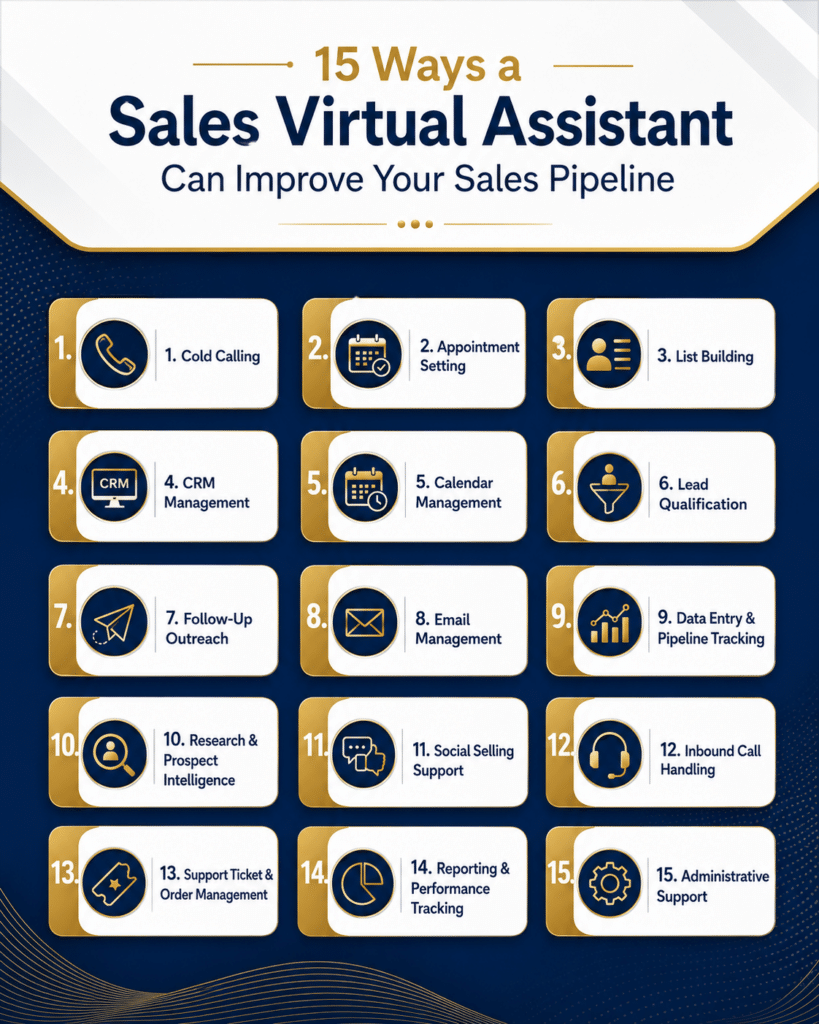
1. Cold Calling
Prospecting volume drives pipeline volume. A sales VA executes high-frequency outbound cold calling campaigns, works through contact lists methodically, and delivers qualified conversations to your closers — without burning out your core team. More dials. More connections. More pipeline.
2. Appointment Setting
Every unbooked lead is a missed opportunity. Outsourced appointment setting services handle outreach, qualification, and scheduling — filling your calendar with confirmed appointments so your sales team walks into each day ready to close, not scrambling to book.
3. List Building
Bad data kills prospecting campaigns before they start. A sales VA researches and builds targeted prospect lists using verified contact information, industry filters, and buyer persona criteria. Clean lists mean higher connect rates and less wasted time chasing dead ends.
4. CRM Management
A CRM only works when it is accurate and current. Sales VAs update contact records, log call outcomes, tag deal stages, and maintain pipeline hygiene in real time. Your managers get reliable data. Your reps get a system they can trust. Decisions improve because the information behind them is clean.
5. Calendar Management
Scheduling friction costs deals. A VA manages your sales team’s calendars coordinating meetings, sending reminders, handling rescheduling requests, and eliminating double-bookings. Your reps stay focused on selling. The logistics handle themselves.
6. Lead Qualification
Not every lead deserves a senior rep’s time. A sales VA applies your qualification criteria budget, authority, need, timeline to inbound and outbound leads before they reach your closers. Only the prospects worth pursuing move forward. Your team stops chasing and starts converting.
7. Follow-Up Outreach
Most sales require between five and twelve touchpoints before a decision is made. Most reps stop after two. A sales VA executes structured follow-up sequences emails, calls, and messages at the right intervals, keeping prospects engaged without letting momentum die. Deals that would have gone cold stay warm.
8. Email Management
Inbox volume is a silent productivity killer. A VA monitors and manages sales inboxes, triages inbound inquiries, drafts responses, and flags high-priority messages for immediate action. Your reps respond faster. Leads do not slip through because someone missed a message buried under 200 others.
9. Data Entry & Pipeline Tracking
Manual data entry is precise, repetitive, and exactly the kind of work a VA executes without error. Your sales VA handles deal entry, stage updates, and pipeline tracking so the numbers your leadership reviews are current and accurate not a week behind because your rep ran out of time to log activity.
10. Research & Prospect Intelligence
Walking into a sales call without knowing the prospect is a waste of everyone’s time. A VA researches company backgrounds, decision-maker profiles, recent news, and competitive positioning before every meeting. Your reps arrive informed, relevant, and prepared to have a conversation worth having.
11. Social Selling Support (LinkedIn, Meta)
Social selling works when it is consistent. A digital marketing virtual assistant manages LinkedIn outreach, connection requests, and message follow-ups, and supports Meta advertising campaigns with audience research, copy coordination, and performance monitoring. Virtual assistant digital marketing support keeps your brand visible and your outreach active. Pipeline does not depend on whether a rep remembers to post.
12. Inbound Call Handling
A missed inbound call is a missed sale. A sales VA answers inbound calls promptly, qualifies the caller, captures contact information, and routes high-value leads to the appropriate rep all in real time. No call goes unanswered. No opportunity evaporates because no one picked up.
13. Support Ticket & Order Management
Post-sale friction destroys repeat business. A VA manages support tickets, tracks order status, and coordinates resolution workflows — keeping customers informed and satisfied. When your clients feel handled, they come back. When they feel ignored, they don’t.
14. Reporting & Performance Tracking
You cannot improve what you do not measure. A sales VA compiles daily, weekly, and monthly performance reports call volume, conversion rates, pipeline velocity, deal close ratios and delivers them in a format your leadership can act on immediately. The guesswork leaves. The accountability stays.
15. Administrative Support
Every hour a senior rep spends on administrative tasks is an hour not spent closing. An administrative virtual assistant handles document preparation, internal coordination, expense tracking, and other admin tasks that take up a sales team’s capacity. Businesses that invest in virtual administrative assistant services reclaim that time directly converting it into selling hours, revenue, and lower overhead.
The Pipeline Problem Has a Precise Solution
A bloated pipeline with no momentum is not a sales problem. It is an operational one. The tasks your team cannot get to — or should not be doing in the first place are the same tasks that determine whether a lead converts or disappears.
The right virtual assistant partner brings more than just task coverage. They match your time zone, your language, and your pace — so there is no lag, no miscommunication, and no ramp-up friction. When evaluating a provider, ask three questions: Do they specialize in sales support, or is it a secondary offering? Do they provide pre-screened candidates, or do you inherit the hiring risk? And what does the cost structure actually look like including hidden fees, equipment costs, and management overhead?
The economics are straightforward. Offshore virtual assistant services typically deliver 40–50% in savings compared to in-house hires, with no payroll taxes, no benefits obligations, and no sick days. A skilled sales VA working 40 hours a week frees your closers from hours of administrative drag each day hours that convert directly into selling time. At the bottom of the decision, one question remains: how much revenue is your team leaving on the table by doing work that should be delegated?
Frequently Asked Questions About Sales Virtual Assistants
How do I know if my business is ready to hire a sales virtual assistant?
Your business is ready to hire a sales virtual assistant if your sales team spends too much time on administrative tasks, misses follow-ups, or struggles to respond to leads quickly. A sales virtual assistant handles these tasks so your team can focus on closing more deals.
How does a digital marketing virtual assistant support the sales pipeline?
A digital marketing virtual assistant supports the sales pipeline by generating leads, managing email campaigns, updating CRM records, scheduling follow-ups, and helping move prospects through the sales process more efficiently.
What tasks can a virtual administrative assistant handle for a sales team?
A virtual administrative assistant can manage calendars, schedule meetings, update CRM records, organize documents, respond to emails, prepare reports, and handle other administrative tasks so the sales team can focus on selling.
Can outsourced appointment setting services replace my in-house team?
Outsourced appointment setting services can replace or support your in-house team, depending on your business needs. They help schedule qualified meetings, improve efficiency, and reduce hiring costs.
What does a sales virtual assistant actually do?
A sales VA handles cold calling, appointment setting, CRM updates, lead qualification, follow-up outreach, and reporting — so your closers stay focused on selling.
What does a sales virtual assistant actually do?
A sales virtual assistant handles lead management, follow-ups, appointment scheduling, CRM updates, email support, and administrative tasks, allowing your sales team to focus on closing deals.