
Key Takeaways
This case demonstrates that customer service can play a critical role in improving business performance when properly structured.
Key lessons from this engagement include:
- Customer service can significantly reduce revenue leakage from refunds and disputes
- Operational inefficiencies often hide significant financial losses
- Data-driven support systems enable better decision-making
- Customer interactions can create opportunities for new revenue
- Well-managed support teams can evolve from a cost centre into a profit centre
Client Overview
A fast-growing U.S.-based D2C e-commerce brand (name confidential due to Non-Disclosure Agreement) was experiencing strong growth in product demand. The company had established monthly sales that exceeded 500,000 dollars because of its strong online advertising combined with high customer demand for its products.
They faced operational challenges because they could not achieve profitability despite their high revenue. The company also went through significant margin losses because of its operational inefficiencies, rising refund rates, and increasing chargeback costs.
Visionary Solutions was engaged to evaluate the situation and help restructure the company’s customer service and operational processes to improve profitability.
The Challenge
The brand achieved high sales growth, but operational difficulties stopped the business from turning its sales into profitable earnings.
The main problems faced by the company were the following:
- Experiencing high refund rates because customers were dissatisfied with their purchases, and orders took too long to arrive.
- Cash flow problems because it faces increasing chargebacks and payment disputes.
- Struggles with two main problems, which include restricted customer service capabilities and the absence of organized support systems.
- Lack of effective methods to track customer complaints and monitor its operational problems.
At one point, the company experienced $148,500 in lost revenue within a single month due to refunds, disputes, and operational inefficiencies.
Without intervention, the business risked continuing to lose revenue despite strong product demand.
Root Causes Identified
After a detailed operational analysis, Visionary Solutions identified several underlying factors contributing to the company’s losses.
Lack of Structured Customer Support Systems
Customer interactions were not being tracked properly, which made it difficult to identify recurring complaints and resolve issues efficiently.
Limited Operational Visibility
The company lacked the analytics tools required to understand refund triggers, dispute patterns, and customer experience issues.
Supply Chain and Fulfilment Pressure
Rapid sales growth had created operational strain on inventory management and fulfilment processes, leading to delays and customer frustration.
Inadequate Customer Communication Channels
Customers had limited access to reliable support channels, which increased frustration and encouraged refunds and chargebacks instead of resolution.
The Solution Implemented
Visionary Solutions implemented a comprehensive operational framework designed to address these challenges and improve the overall customer experience.
Customer Support Infrastructure
A structured customer service operation was established, including:
- Dedicated support agents
- Ticketing and customer case management systems
- Organized tracking of complaints and inquiries
This allowed the company to manage customer interactions more efficiently and identify operational issues more quickly.
Data and Business Intelligence
Visionary Solutions implemented analytics tools that provided visibility into refund patterns, dispute triggers, and operational inefficiencies.
This helped the company make better decisions regarding:

- production planning
- inventory levels
- customer service response strategies
Multi-Channel Customer Communication
To improve the customer experience, the following communication channels were introduced:
- Toll-free voice support
- Live chat assistance
- Social media support
Providing accessible support channels helped resolve issues faster and reduced the likelihood of refunds and disputes.
Operational and Logistics Improvements
Visionary Solutions also assisted with improvements to warehouse and fulfilment processes. Better logistics management reduced delays and improved overall order delivery reliability.
Results and Business Impact
After implementing these changes, the company experienced significant operational and financial improvements.
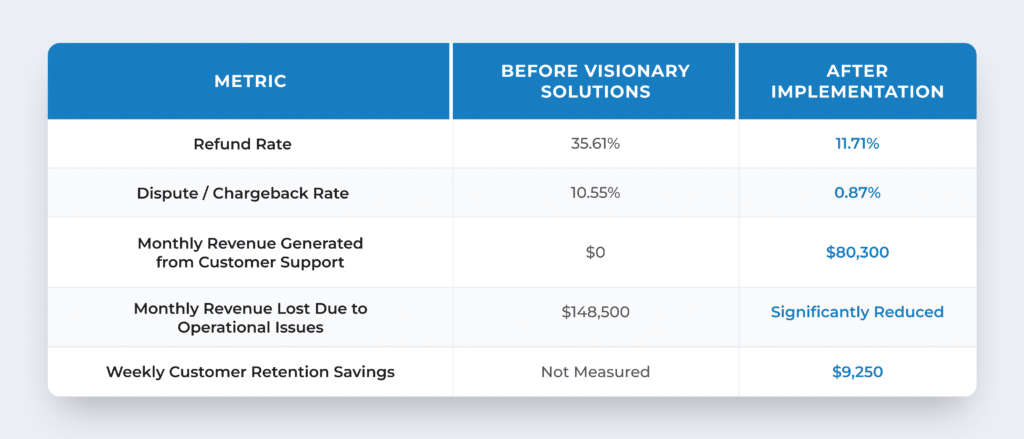
Refunds and disputes were reduced substantially, and customer service began contributing directly to revenue through customer inquiries and product-related support conversations.
Below is a summary table of the key improvements achieved:
An important development from the data gathered during the company’s early stages was the fact that customers were contacting customer service representatives prior to making purchases to ask about their product selection. This created an opportunity for agents to make product recommendations based on these inquiries, thus creating sales and profits.
This information ultimately led to the company creating an internal sales department, with assistance from the information collected through customer service.
Finally, the customer service area generated approximately $80,300 per month from sales, while the operational expense of the customer service area incurred approximately $40,000 per month in costs, thereby costing the business as a whole nothing, as they were making direct profits.
Conclusion
While many businesses in the rapidly expanding E-commerce sector spend a great deal of time on marketing and sales for their products and/or services, it is often the case that they neglect operational infrastructure and customer service as components of a successful business paradigm.
Visionary Solutions helped to transform the struggling Support (Customer Service) division into a revenue-producing, strategic department by implementing processes, enhancing customer communications, and employing metrics to enable fact-based decisions to be made.
For the companies that are experiencing large numbers of refunded transactions, customer disputes, or operational inefficiencies, having a well-thought-out Customer Service Strategy will assist in protecting your revenue, improving your customer retention rate, and creating new growth opportunities.
FAQ
- What is the role played by customer service in the profitability of an e-commerce business?
Customer service will be able to directly influence profitability by decreasing customer dissatisfaction, refunds, and chargebacks. A properly designed support system enhances customer experience, retention, and can even lead to increased revenue as a result of product recommendations and pre-sales support.
- What are the primary reasons why there are high rates of refunds and chargebacks in e-commerce?
Late delivery, ineffective communication with customers, absence of customer support, and unmet customer expectations are some of the factors that normally attract high refund rates and chargebacks. Revenue loss is also contributed to by operational inefficiencies as well as non-visibility into customer complaints.
- What are some of the ways through which businesses can minimize refunds and disputes?
Legal refunds and customer disputes can be reduced by instituting formal customer support systems, providing multi-channel support (chat, call, social media), enhancing the fulfillment process, and applying analytics to prevent situations that may cause a recurrence by identifying and addressing them beforehand.
- Does customer service bring income to a company?
Yes, customer service will be a profit-making operation. When the support teams interact with the customers before purchasing, a way to turn the interactions with customers into sales is by recommending products, upselling, and advising on purchasing products.
- How can data and analytics be used to enhance the operations of customer service?
Analytics and data are used to assist businesses in understanding trends in customer complaints, refund triggers, and operational inefficiencies. This enables companies to make better decisions, streamline their operations, and increase customer satisfaction, which would eventually result in improved financial performance.